What Claude Code did on Wake while I had breakfast
 Wake
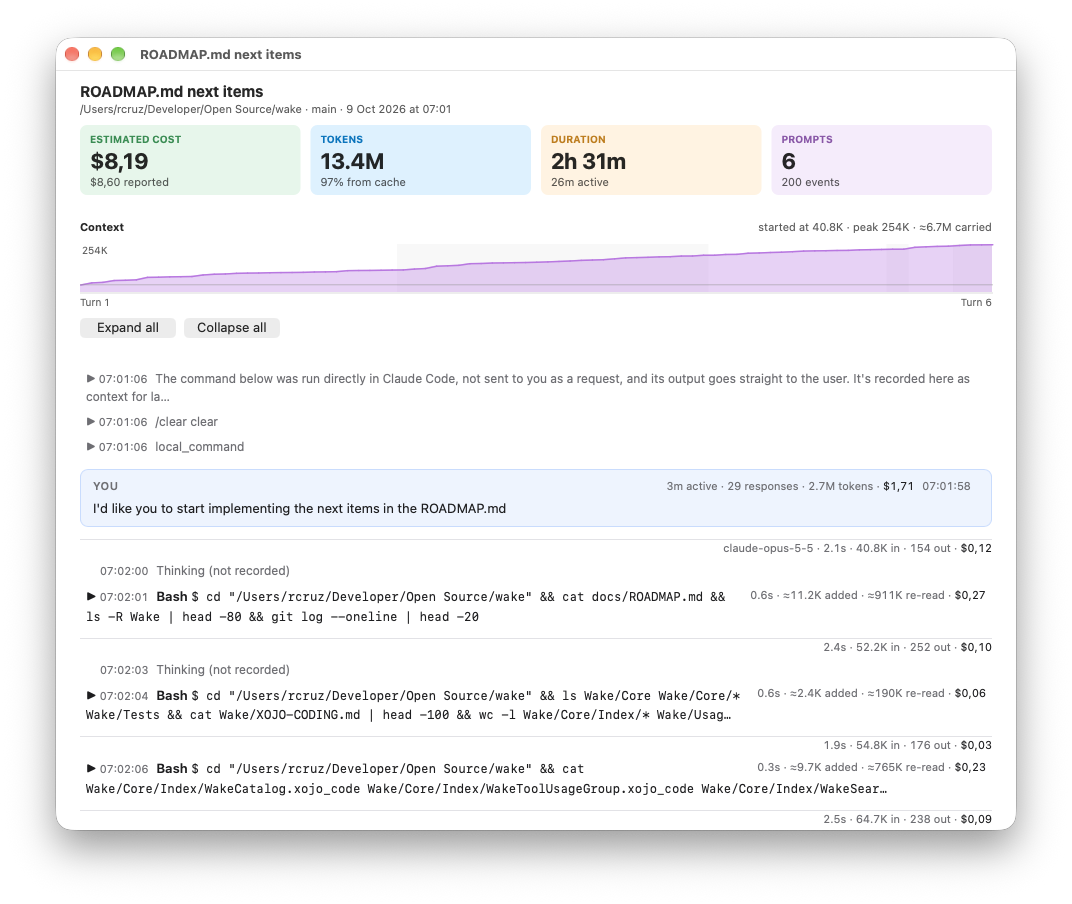
Wake is mostly written by Claude Code. Wake also reads Claude Code sessions, so it can show how it was built. This is one of the biggest sessions in the project.
The prompt
On October 9 at 07:01, before starting my real job, I opened Claude Code in the Wake project and wrote:
I’d like you to start implementing the next items in the ROADMAP.md
Then I went to have my breakfast.
Mostly on autopilot
I told Claude to implement things on its own. Wake is a pet project, so I could let it do that. The agent did the job mostly on autopilot, because Wake has a lot of automated tests.
Xojo’s Agentic Mode does the rest
The tests are one half of it. The other half is that Wake is a Xojo project with Agentic Mode turned on. It is a feature of the Xojo IDE for building an app together with a coding agent, and the two work really well together:
- The agent edits the project directly. The project is saved in the text-based Xojo Format, so the agent can read and change it like any other code.
- Xojo teaches the agent. Agentic Mode keeps two instruction files in the project
folder,
AGENTS.mdandXOJO-CODING.md. They explain Xojo’s code conventions, where the documentation is, and how to work with the project files. You can see it in the screenshot: in its second command, the agent readsXOJO-CODING.md. - The IDE keeps up. Every time the agent changes a file, Xojo reloads it and lists the reload in the Messages pane, so I can review everything it did.
- The agent can run the app. If the run shows errors, the agent sees them, fixes them and runs it again.
- I can always step in. I can run the app, edit the code by hand, or prompt the agent again at any time.
Agentic Mode plus a good set of tests is why this session could run mostly on its own.
As I said in the Wake 1.0 post, I work at Xojo, and testing Agentic Mode on a real app was one of the reasons I built Wake.
Not only Claude Code
I use Claude Code, but Agentic Mode works with any coding agent. Xojo’s documentation mentions Claude, Codex, Gemini and Muse as examples.
The numbers
This is what Wake shows for that session:
- 2 hours 31 minutes from start to end, but only 26 minutes active.
- 6 prompts from me.
- 13.4M tokens, and 97% of them came from the cache.
- $8.19 estimated by Wake. Claude Code reported $8.60.
The context started at 40.8K tokens and grew to a peak of 254K. Over the whole session, about 6.7M tokens were carried from one turn to the next.
Small reads, big totals
Look at the first command in the screenshot. The agent read ROADMAP.md, listed the
project files and the last commits. That added about 11.2K tokens to the context. But
every reply sends the whole conversation again, so by the end of the session those tokens
had been re-read over and over: about 911K tokens in total.
That is what Wake is for: one command looks cheap, until you see what it carried.
The whole project so far
For all of Wake, at the time of writing:
- 42 sessions and 212 prompts.
- 242M tokens, 98% from the cache.
- $118.40 estimated.
- 1 day 11 hours of sessions in total.
If you want to see these numbers for your own projects, download Wake. It is free, and it never goes online.